
What if the sanitation solutions already serving millions in informal settlements could generate their own financing? Drawing on fresh analysis presented at the Lee Kuan Yew School of Public Policy, GWSC examines the potential and the prerequisites of integrating fecal sludge management into water crediting frameworks. This article serves as call for collective inquiry.

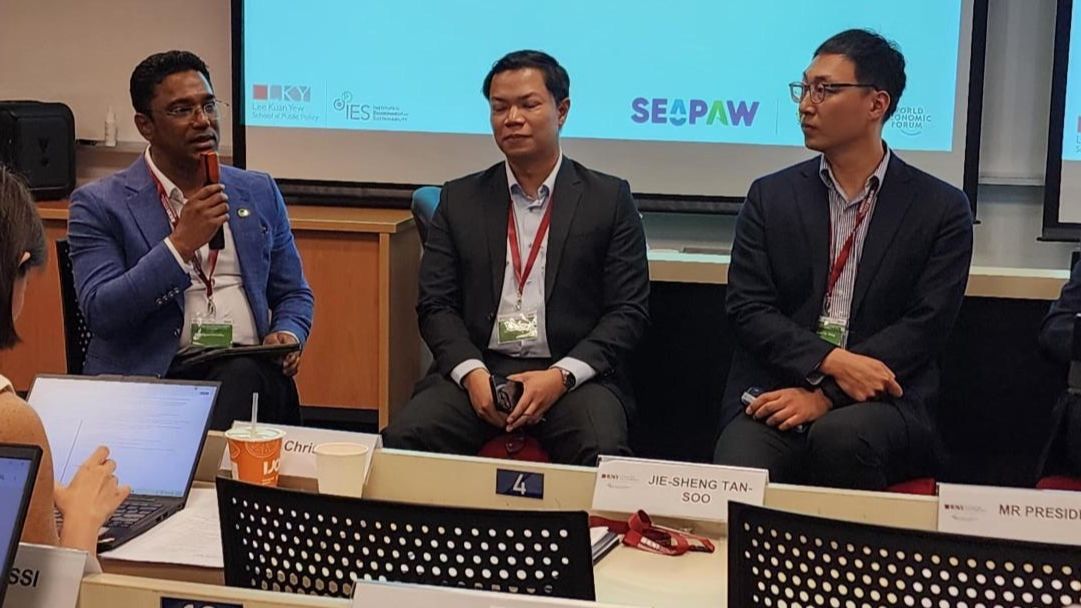
Earlier this month, GWSC leadership, Prof. Sangam Shrestha and Prof. Thammarat Koottatep, joined global experts at the Lee Kuan Yew School of Public Policy, National University of Singapore, for a high-level workshop on “Future of Water: Stewarding Water Resources Management through Innovative Finance Tools.”
The message from Singapore was clear: innovative finance is no longer a theoretical promise; it is an urgent necessity. With 3.6 billion people globally still lack access to safely managed sanitation and nearly half a billion people still practice open defecation, while according to the World Bank, achieving universal access to water, sanitation and hygiene by 2030 will require approximately 114 billion US dollars per year in capital financing, this figure is three times current investment levels. There is a need for a breakthrough in sanitation financing.
Nevertheless, Prof. Sangam in his talk emphasized that such mechanisms cannot simply copy-paste models from carbon markets. For water credit financing to be credible, it must be built on a foundation of strong governance, institutional transparency, and deep engagement with social and political realities.
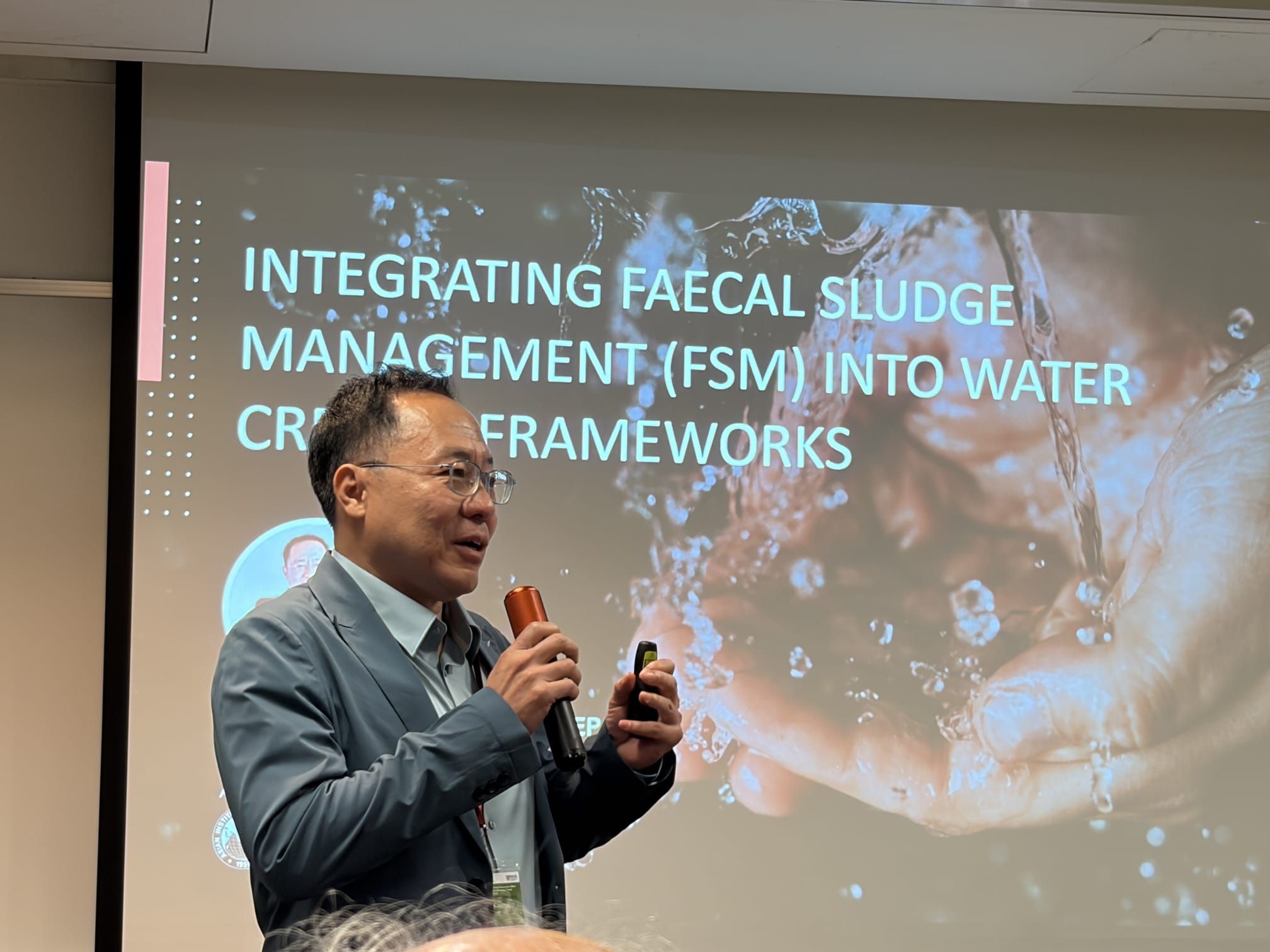
Prof. Thammarat brought this principle to life, presenting a transformative approach to integrating fecal sludge management into water credits frameworks. Drawing on decades of research and recent analysis, he demonstrated that safely managed sanitation in dense, underserved settlements can be quantified, verified, and financed, at five to forty times lower cost than conventional sewers.
These two insights from GWSC Co-Directors: governance as the foundation and fecal sludge management as a high-impact opportunity are forming a potential mechanism for a credible, equitable water crediting scheme to transform sanitation in significant ways and currently GWSC is exploring and marking its role to play.
Fecal Sludge Management and its Potential
Fecal sludge management (FSM) refers to the systematic and safe containment, emptying, transport, treatment, and reuse or disposal of excreta from on-site sanitation systems such as septic tanks and pit latrines. Unlike sewer networks that convey waste through pipes to centralized treatment plants, FSM addresses the reality of most urban contexts in the Global South: dense settlements where conventional sewers are technically or financially not feasible.
The service chain is straightforward but challenging to implement at scale: safe containment in sealed tanks, scheduled desludging by vacuum trucks, transport to treatment facilities, and finally treatment that enables safe reuse or disposal. Each link in this chain must function for sanitation to be truly “safely managed.”
Prof. Thammarat’s presentation quantified what effective FSM can achieve. When fecal sludge is safely contained, transported, and treated, pollution loads are avoided. That avoided harm has measurable value.
Consider the numbers from a hypothetical scenario in which Thailand increases safely managed sanitation coverage from 20 percent to 80 percent of its population, shifting approximately 42.6 million people to safely managed services. The environmental impact would be substantial: more than 600,000 tonnes of biochemical oxygen demand (BOD) managed annually, with roughly half of that representing pollution actively prevented from entering waterways. Methane avoidance could reach nearly 100,000 tonnes annually, translating to over 2.5 million tonnes of CO2 equivalent reduced and these can be valued as carbon credits.
The health and productivity gains are equally striking. Reduced diarrheal disease alone could save an estimated 500 million Thai baht (about 14 million US dollar) annually in healthcare costs and loss of productivity. These are illustrative numbers, but they point to a clear conclusion: fecal sludge management is not a side issue, it is a major lever for environmental protection, climate mitigation, and public health. These are highly regarded values in emerging credit markets.
How FSM Generates Creditable Outcomes
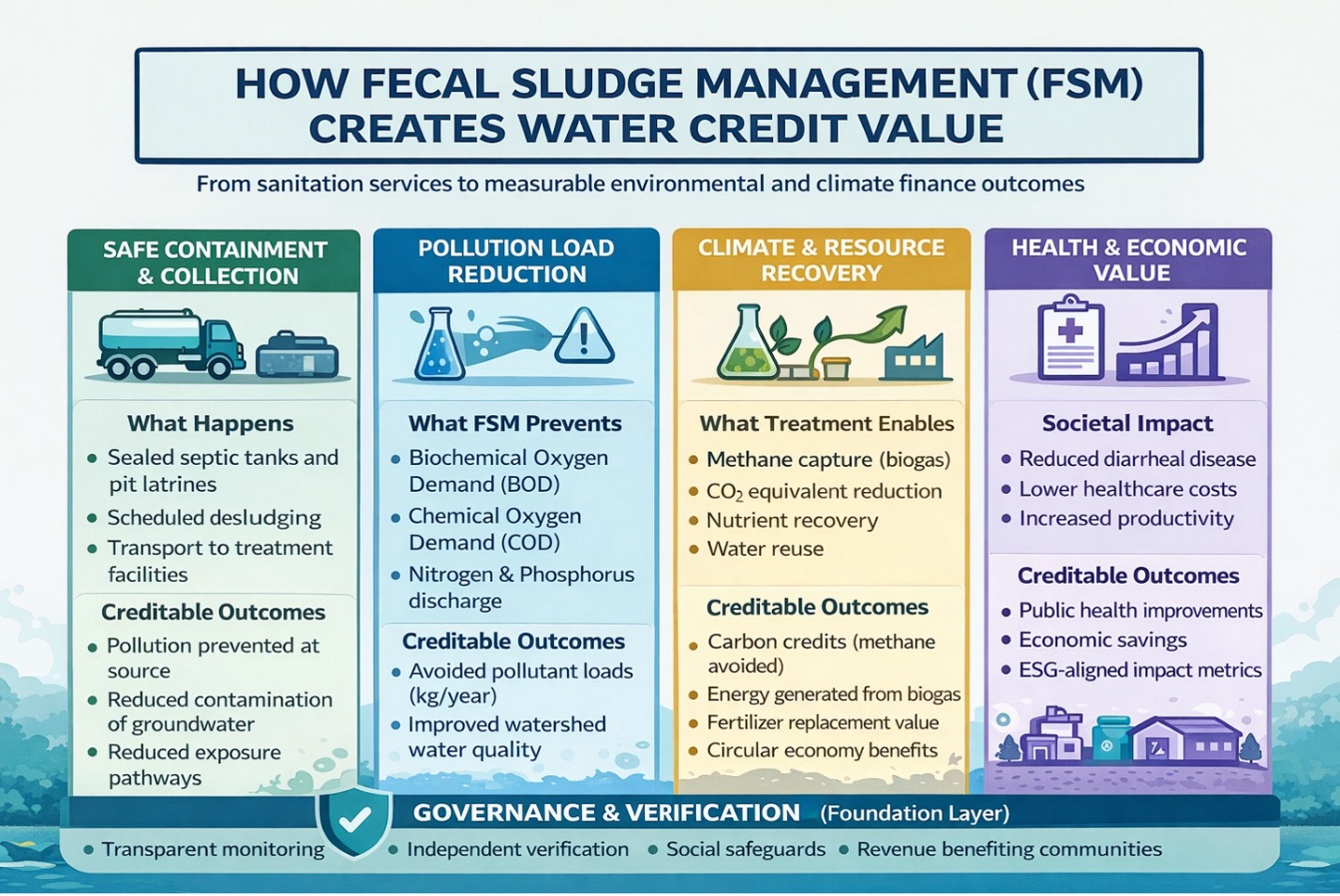
The core insight of Prof. Thammarat’s talk is that FSM produces multiple, measurable outcomes that could potentially be converted into credit units. These include:
- avoided pollution loads measured in kilograms of biochemical oxygen demand, chemical oxygen demand, nitrogen, and phosphorus reduced;
- carbon credits earned;
- volumes of water resources protected at the watershed scale; and
- treated effluent safely reused.
Critically, FSM enables stacked environmental benefits. Beyond water quality improvements, properly designed systems can generate carbon credits through biogas recovery, reduce contamination of wells and drainage, and align with multiple SDG targets. Treated sludge can be reused as fertilizer or energy, reducing pressure on water-intensive agricultural systems and displacing synthetic fertilizers that carry their own environmental footprint.
The monitoring frameworks to track these outcomes are increasingly well understood. Public health improvements can be tracked through population served, reduction in exposure pathways, and diarrheal disease incidence. Climate mitigation can be measured through methane captured versus released, energy generated from biogas, and emissions avoided. Resource recovery can be quantified through volumes of biogas produced, nutrients recovered, and water reused.
These are already wide applications of these metrics. They are the same indicators that industry already uses for environmental, social, and governance (ESG) reporting, greenhouse gas accounting, and circular economy benchmarking. The infrastructure for measurement largely exists, what remains is the work of assembling it into coherent, verifiable credit methodologies.
The Governance Gap in Water Markets
We have recognized the potential, now we talk about the enabler and this is where Prof. Sangam’s framing becomes essential. The existing carbon markets have taught us a hard lesson: credits are only as valuable as the trust behind them. Without transparent institutions, clear methodologies, and inclusive governance, environmental markets can exacerbate inequality rather than solve it.
Prof. Sangam’s reminder in Singapore was timely that water credits must take this into serious considerations. They cannot be designed in boardrooms and imposed on communities. They must reflect transboundary realities of water, that in the context of water, it is difficult to put administrative boundaries. They must embed social safeguards, ensuring that revenue flows benefit the households which contributed directly or indirectly to the creation of the credit value. And they must maintain public trust through rigorous, transparent monitoring and independent verification.
This is the essential precondition for any credible water credit mechanism if the aim is to enable sustainable sanitation financing with impacts on the ground.
The exploration begins
One thing that we need to clarify here: GWSC is at the very start of this exploration. We do not have ready-made solutions or proprietary models. What we have is a recognition that innovative finance tools like water credits warrant serious inquiry and that our Center, with its unique positioning, have a contribution to make.
The Singapore workshop was not a declaration of a new program. It was an invitation to begin asking the right questions. How can water credits be designed to serve frontline communities, not just corporate offset buyers? What methodologies would make sanitation credits credible, verifiable, and equitable? How do we ensure that monitoring costs do not swallow the value generated? What governance structures prevent the privatization of essential services? And most fundamentally, can this work at all?
These questions have no easy answers. They will require years of dialogue, experimentation, and learning, not by any single institution, but by a coalition of actors bringing diverse expertise and on-the-ground reality.
What GWSC Brings to the Table
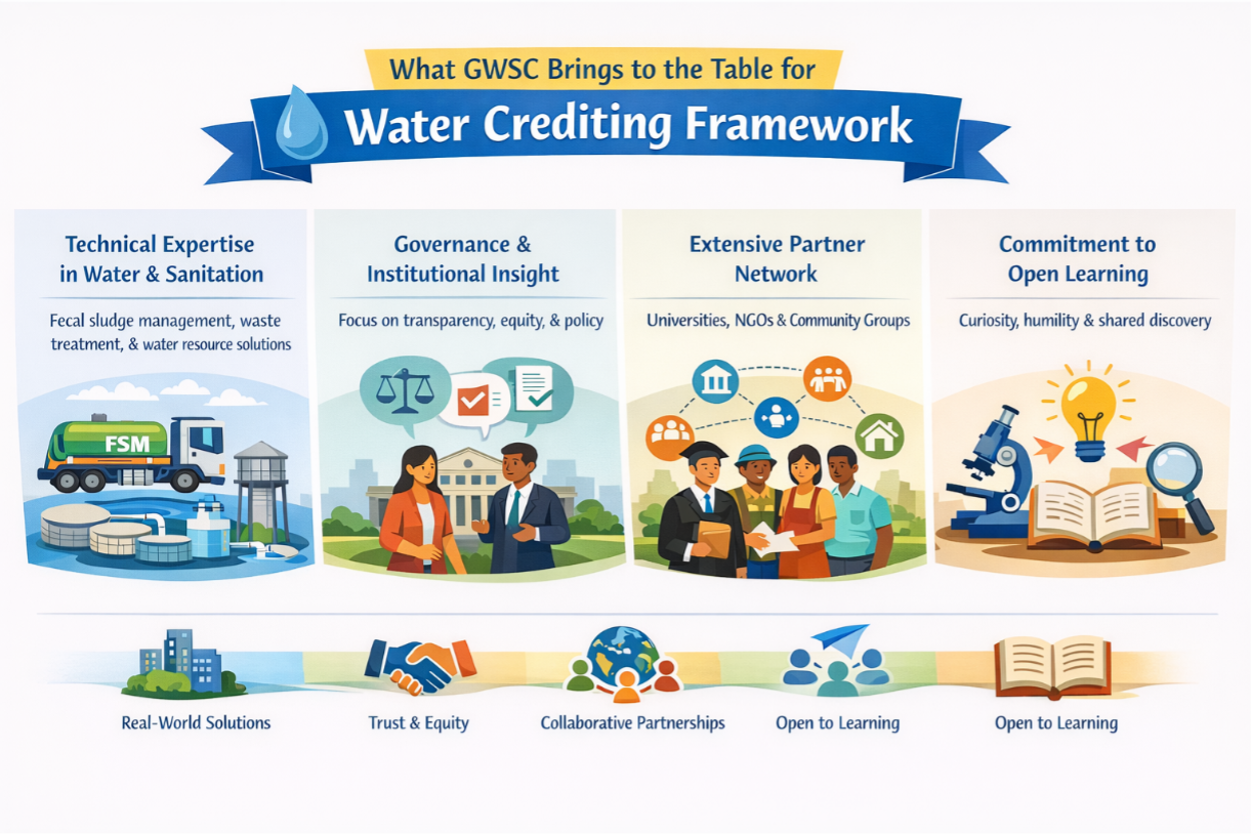
If we are to explore this frontier responsibly, it will require a collaborative effort. No single organization possesses all the pieces. Based on our decades of experience in water and sanitation across Asia and beyond, GWSC can contribute in several ways. We have technical expertise in water and sanitation systems. Through Prof. Sangam and Prof. Thammarat’s works, as well as many experts at AIT and our broader research portfolio, we offer deep understanding of fecal sludge management, waste treatment technologies, water resource management, and the real-world constraints of delivering clean water and sanitation in dense, underserved settlements. Any credible water credit mechanism must be grounded in this technical reality.
We bring a governance and institutional perspective. Prof. Sangam’s emphasis on governance reflects GWSC’s longstanding commitment to understanding water not just as an engineering challenge, but as a social, political, and institutional one. We can help ensure that explorations of water credit remain anchored in questions of transparency, trust, and equity.
We bring an extensive partner network. GWSC works with universities, utilities, NGOs, and community-based organizations across the region. We do not pretend to represent communities, but we can help convene the conversations that bring their voices to the table.
And we bring a commitment to open learning. We are not entering this space with a predetermined solution to promote. Our approach is one of curiosity and humility, learning from partners, testing assumptions, and sharing what we discover, whether it confirms promise or reveals dead ends.
GWSC believes on this matter, no single institution holds all the answers to the questions this frontier presents. The complexity of designing mechanisms that are both financially innovative and socially equitable demands diverse perspectives, from researchers who understand water quality modeling to community organizers who understand the daily realities of informal settlements. Genuine progress will require collective inquiry.
For GWSC, this means approaching the exploration of water credits not as a program to be launched, but as a conversation to be joined. We are listening for the insights of utilities grappling with fecal sludge management, the concerns of communities who must benefit from any mechanism designed in their name, and the questions of policymakers and investors wondering whether these tools can deliver on their promise. If these questions resonate with you, we hope you will reach out, not with proposals, but with curiosity. Should opportunities arise to develop joint proposals that advance this exploration, and where funders are willing to invest in answering these questions together, we would be pleased to contribute GWSC’s expertise and perspective. There is much to learn together.
We are grateful to the Institute for Environment and Sustainability (EIS) and the Southeast Asia Partnership for Adaptation through Water (SEAPAW) for sparking these conversations in Singapore. We hope to continue our engagements to drive this momentum. And we look forward to hearing from partners across the region and beyond who want to explore these questions together.
For inquiries, collaboration discussions, or to share your perspective on water credits and innovative sanitation finance, please contact:
Agus Nugroho (agus@ait.asia)
Global Water & Sanitation Center